
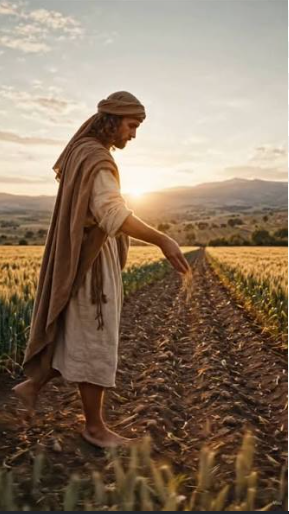
Isaiah 55: 10-13; Matthew 13: 1-9, 18-23
Gardening and farming runs extensively in my family. Every year, on my dad’s side, they would plant a large garden of fruits and vegetables including beans, corn, pumpkins, watermelons, peppers, cucumbers, and potatoes. It was almost always an incredible harvest followed by canning things for winter. On my mother’s side, my grandmother had tons of flowers on her porch, and my grandfather could do a great garden as well, though on a smaller scale.
I had long hoped to inherit this skill. I had dreams of growing my own tomatoes, veggies, and having a small garden, especially when I owned a house and land. But alas, I have learned a hard lesson. Not only can I not raise plants, I could kill silk and plastic flowers. A green thumb, I do NOT have.
I think Jesus has a soft spot for those of us without a green thumb when he tells us this parable. Many preach on this parable and simply reiterate the conclusion he shares later on in Matthew. But that tends to just repeat Jesus and not fully explain his meaning of what it means to plant and sow in this world. We know Jesus speaks in the form of a parable here. It’s one of his earliest parables in the Gospel of Matthew. Now, a parable is essentially a comparison, or “using something else to explain” your ultimate meaning. But more importantly, a parable doesn’t communicate a life lesson, a moral, or a note of encouragement. A parable communicates something to us about Jesus and his work in our lives.
In this parable we get a comparison of the Word of God and planting of seeds. It’s a story about the Good News and how ready hearts may be to receive it. The parable talks about those who are too shallow to understand and receive the Good News. It talks about those who don’t have the depth to maintain their faith and commitment. It talks about those who let all the worst parts of life choke out the goodness of God’s word, and all of God’s blessings. And finally, the parable tells us of fertile soil, warm and open hearts ready to receive what God says and follow God in all ways. But a parable is more particular than the life lesson that we need ot have open hearts and minds to listen to God.
A parable, remember, teaches us something about Jesus and his work in our lives. So, what more can we glean from this parable? There are three characters at work here in the story. First is the farmer or sower of the seeds. Second is the seeds themselves, and third is this unseen power. A farmer can toss out seeds all day, and seeds can land on ground till the cows come home, but there is something we don’t see and experience and do that makes those seeds sprout and grow. They cannot grow without a farmer to sow the seed. Nothing will grow without seeds themselves. Seeds also usually need some tending—water, fertilizer, weeding—but it’s not completely necessary. But ultimately it is this unseen power that brings some kind of life out of this seed that is most important. This new life can burst forth from a seed with or without our help and influence. It is something unseen and powerful within the seed itself.
The important part of this parable is this mysterious, concealed working of God who miraculously brings the harvest. Isaiah tells us the same thing in God’s own voice: “It is the same with my word. I send it out, and it always produces fruit. It will accomplish all I want it to, and it will prosper everywhere I send it.” God’s work and God’s plans work in and above and sometimes against human pretentions and expectations. This word is a prophecy to the people. Where there were once thorns and briars, there will be trees and gentle vegetation.
Thorns, briars, and nettles signify judgment, and the removal of those is a story of restoration and hope. But, God warns there must be repentant and willing hearts, eager to listen. Isaiah emphasizes for us that repentant hearts make for willing ears. Perhaps that gives us a better explanation of the parable when we think of infertile and bad soil as a judgment, unresolved issue, or pent up anger, often imposed by us and independent of all the goodness God wants to do in our lives. Those who have been hurt by church or church folks often become the foot path. They don’t want the seeds to take root because the last time it ended in hurt and brokenness.
Those who have rocky soil want a quick fix and easy life, and learning that faith is a road of commitment and not a quick medicine to life’s troubles is not going to work for them. Those who are the thorns and briars have something in their lives that they love more than God. As much as they want to have faith, they are stuck in something here that stands in between: pride, old angers, addiction, a deep-rooted love of something that’s thrilling but ends in harm, the way they want things done and control. When God says no, or when God’s call comes into contact with one of their carefully manicured thorns, it dies.
That is because the fertile soil, the germination and growth of the seed is something we cannot control. It is something that happens unseen and outside of our best abilities. We cannot go down in the dirt and make it happen. We can only plant the seed, nurture it, and pray with all our being that it miraculously sprouts forth into new life. We are told in the parable that where there is fertile soil and this unseen work of God, the harvest will be incredible.
Ten to fifteen times harvest to planted seeds was considered huge. For Jesus to say 30, 60, or 100 is an unbelievable number to the crowd. So, here’s the hard part of the lesson for us: what we plant today doesn’t immediately sprout up. Planting a garden or a flower bed is an investment in the future. It may take months for the harvest to come in, or it may take one year for the flowers to truly reach their own. Sometimes you may not see the fullness of what you plant in your lifetime. As an example, Macon is full of Yoshino cherry trees. That didn’t happen overnight. A cherry tree of that variety takes 10-20 years to fully grow.
It is the same with the seeds we plant in faith. I remember growing up in church we always had a long prayer time. Folks would request prayer for the same family members over and over to find faith and trust in God. It took years, and in some cases decades, but eventually every single person on that list was inspired to know the love and grace of Jesus for themselves.
What you do today in faith is an investment in the harvest of tomorrow. You teach your children about faith and living like Jesus, so they can live into that goodness in adulthood. You give generously and lovingly to those in need because it plants a seed of God’s love in their hearts. You work to better yourself and overcome old habits and the bad places of life, so that you can live for God each day thereafter. Any teacher will tell you that the fruit of that labor is seen years down the road. Planting seeds is an investment in the future not an act of immediate return here and now.
Whether or not we are blessed with a green thumb, whether or not we could kill plastic flowers, we can all plant seeds of faith and hope. For our part, we must plant the seeds and pray for a fertile soil. Then we wait. The other part of this equation is that God will work in miraculous and powerful ways to take that seed and call out life from it. A good garden of faith and hope need both of these things: willing planters and a little bit of trust in God. Don’t give up planting the seeds of God’s love and faith. We may not know when, but one day, the harvest will come, and it will be more incredible than we can ever imagine.
Worship Service Video https://www.facebook.com/fccmacon/videos/1325724126211757