
Healing—Psalm 23: 1-2, 6; John 9: 1-38
When traveling, I listen to a podcast called “Swindled,” that talks about large-scale fraud and financial crime. The latest episode was truly uncomfortable. It talked about “The Apostle” David E. Taylor, of Joshua Media Ministries International or Kingdom of God Global Church. Taylor built his ministry on claims of face-to-face dreams and visions of Jesus, who spoke to him, and how Taylor taught his other leaders to do the same. Further he had a substantial faith healing ministry…you know…the kind where the pastors touch you and fall down flailing only to get up fully healed of some issue conveniently incapable of being scientifically tested.
Let me fully say this here and now. God’s healing does not come in chaos, theatrics, and insanity. God absolutely brings healing in this world and our lives. But it is not some magic from a human who has made themselves out to be a god themselves, and, as they say, pride goeth before a fall. The Apostle and his leadership were indicted in August of 2025 for forced labor, conspiracy, and money laundering. His donation-based empire was staffed by what was essentially slave labor according to the indictment.
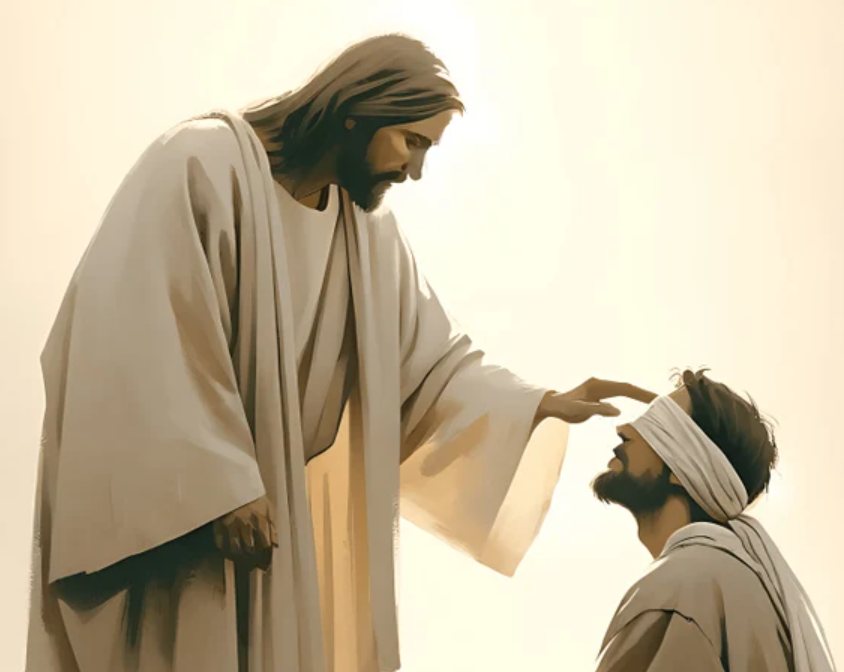
For as long as there have been stories of faith-based healing, there have been charlatans to take advantage of our belief. We read in today’s Gospel that the religious leaders accuse Jesus of being Satan’s charlatan and of violating the Sabbath rules for healing a blind man. We read in this lesson something that offends our modern beliefs. The disciples ask Jesus what sin caused the beggar to be born blind—his or his parents’ sins. It was common belief in those days that physical impairments were tied to sin.
That is simply not true. Sins can lead you to natural consequences, but God doesn’t visit suffering upon you just to punish you for generations of wrongdoing. If you do risky things you may end up paying the price, but Job is an illustration not the everyday expectation. Remember the words of Jesu here that in every trial or harsh circumstance, the power of God can be seen in us. Sometimes that in the miraculous and sometimes that’s in our own healing and acceptance of living with trials.
The town was incredulous at what had happened. They could not believe the blind beggar they had known for so many years had been healed and had his sight restored. In the Gospel of John, however, healing is always two-fold. There is a physical healing, but there’s also a spiritual healing. Yes, the man had his sight restored, but look at how his soul was also blind, but now has sight. In verse 11 he attributes his healing to “the man they call Jesus.” As he is challenged by the Pharisees, he says in verse 17, “He [Jesus] must be a prophet.” By the end, verse 38, his sight is perfect and he sees Jesus as the Messiah.
The hardest part for us is when we don’t get the miracle we wanted, so we go in reverse from Christ, to some prophet, to some guy named Jesus. Faith is not willing yourself into a physical miracle. Faith is, instead, saying “It is well with my soul” in every circumstance we face. If our faith and hope rest only on how we are cared for here in this world, we miss the point of following Jesus, of deliverance, and of death and resurrection.
We cannot fall into the double-minded debate trap of the Pharisees. Some said that Jesus was not of God because he healed on the Sabbath, and that broke the rules. Others wonder how Jesus could have such power if he is not of God. It’s quandary. Their understanding, their belief is unsettled. They cling to this law and the life and story of Moses. But Moses is not a redeemer. Laws are not redemptive. Only Jesus is redemptive, and in that redemption, we find our healing. True discipleship is faithfulness to grace and the truth of Jesus, not the law.
The trouble for them is that they cannot believe Jesus is a sinner and has the power of God to cure and heal at the same time. Thus, they interrogate the healed man, they interrogate his parents, then they interrogate him again. By this point they only look silly. They have lost sight, if you will, of the miraculous healing and the joy of this work of God to focus on the nitpicky rules they don’t like Jesus violating. I’m sure we’ve never seen that in the past in our churches, right? While we get caught up on the miraculous healing, Jesus reminds us that healing begins with the soul and spirit. The Pharisees end up cursing and insulting the man who was healed, and he goes on his way filled with grace.
Sometimes, the church has to wade into the mess to make healing happen. Earlier this year we watched in horror as protests over immigration policies erupted in Minneapolis. Following two deaths and a city on the brink of total chaos, many of us feared where this would end up. But something different happened. The churches in the city opened their doors and brought people in. Clergy came to the city to help calm the struggles. In a situation brimming with hostility and nearing warfare, the clergy and churches began helping cultivate a program called “Singing Resistance Twin Cities.”
Instead of devolving into hand-to-hand combat, protesters were taught organized ways of protest stemming from the 1960s and 70s nonviolence movement. They began walking calmly singing hymns songs guided and cared for by local and national clergy aimed at protecting safety. Whatever one believes on these protests and policies, healing happened, calm and peace came about because God’s people, the church stepped in to provide guidance and support. We may not agree on everything, but we are called to love our neighbors and to seek Christ in the most turbulent and tumultuous situations.
Many of us see healing as God miraculously making a cancer disappear. And yes, that absolutely can happen. I have actually seen where prayer made a difference in such a situation. But we also cannot discount the work, our calling, of healing and helping the soul of each person and the collective spirit of God’s people. If the church wants to reignite a passion and purpose, then let it be in demonstrating grace and healing in our world. Let us be firm in rejecting what is sinful and wrong but loving and Christ-centered in how we deal with others. First and foremost, we live in a world of people who are in need of redemption. They need spiritual sight to know what love and faith truly look like.
In writing about this Gospel lesson, one commentator said that we see the transformative power of the love of God as experienced and seen in the life of Jesus, and we must let God shape our own lives accordingly. To what do we conform our lives? How do we pattern our steps, our decisions, and our daily walk? Does it seek to honor Jesus and love our neighbors? Accountability and grace are not mutually exclusive. Faith and healing are not opposite ends of the spectrum. In our Gospel, Jesus healed the man’s sight and his soul. It’s all part of the same body.
The Rev. David E. Taylor built an empire peddling what he alleged were faith healings. A federal grand jury called it fraud, money laundering, and exploiting people who genuinely had faith in God and the reverend. Over and above the noise of folks like that, the church still has a calling to be a place of healing. How many of you came to this church and can say that you felt joy again after an abusive prior faith experience. How many can say you felt broken and isolated but found a community that loves you. How many can say you’ve felt welcomed regardless of whatever has happened in life? How many can say you know God is with you? The more about Jesus that we know and share, the more we will hear those words of the blind man, “I once was blind, but now I see.”
Worship Service Video https://www.facebook.com/fccmacon/videos/1410780264155928